
How Much Front-Desk Time Are You Really Saving? A Simple Automation ROI Model

Sara D.
Head of Onboardings
“We save one FTE” sounds great, but leadership needs a transparent model. This framework gives operators and founders a way to calculate savings and defend assumptions.
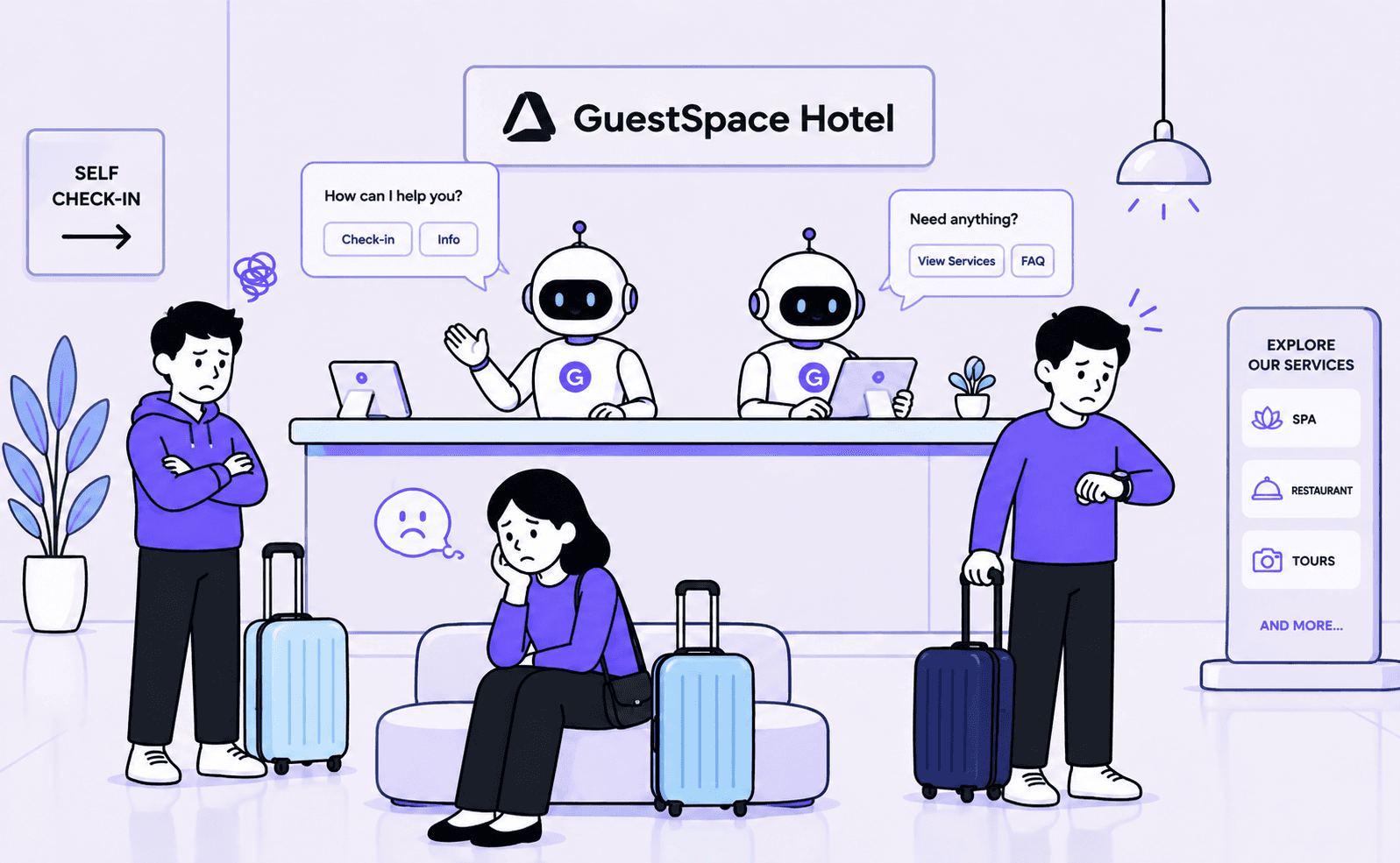
“We save one FTE” sounds great, but leadership needs a transparent model. This framework gives operators and founders a way to calculate savings and defend assumptions.
Why read this now?
You’ll get a practical framework, measurable KPIs, and implementation steps that can be actioned by operations teams this month.
Input assumptions you need (and where teams guess wrong)
Occupied rooms per day.
Average inbound guest messages per occupied room.
% repetitive requests suitable for automation.
Manual handling time per request.
Loaded labor cost per hour.
Core formulas you can use immediately
Manual minutes/day = occupied rooms × messages × handling time.
Automatable minutes/day = manual minutes × repetitive-share.
Recovered hours/month = automatable minutes/day × 30 / 60.
FTE equivalent = recovered monthly hours / productive monthly hours per FTE.
Revenue side (don’t ignore this)
Incremental upgrade revenue from automated offers.
Payment completion uplift due to faster pre-arrival flow.
Lower service-recovery costs from fewer unresolved chats.
Scenario table to include in your board pack
Conservative case (low automation + low conversion).
Expected case (moderate automation + baseline conversion).
Upside case (high automation + optimized upsell timing).
Validation checklist
Compare model vs actuals monthly.
Keep assumptions explicit and versioned.
Separate labor savings from avoided future hires.
Data points to strengthen this article
Labor context: AHLA staffing surveys continue to show broad labor constraints, making productivity improvements strategically important.
Source: https://www.ahla.com/news/65-surveyed-hotels-report-staffing-shortages
Suggested visuals (to make this post more useful)
ROI calculator screenshot (inputs and outputs).
Before/after chart: manual handling hours per week.
Waterfall chart: labor savings + upsell uplift − software cost.
Free image search starting points: https://unsplash.com/s/photos/hotel-front-desk | https://www.pexels.com/search/hotel/
SEO implementation checklist for this post
Use a compelling title tag (50–60 chars) with keyword near the start.
Write meta description (140–160 chars) with clear value proposition.
Add FAQ section + FAQ schema.
Add 3–6 internal links to product pages, case studies, and related posts.
Add Article schema and set canonical URL.
Add one custom chart/diagram so the page has unique assets.
Conclusion
The best hotel content is specific, practical, and measurable. If readers can apply it in tomorrow’s shift briefing, it will outperform generic thought leadership.
Read Next



Copyright © 2026 All rights reserved.

Top 3 Guest Apps
Globally
2026

Made in
the Netherlands
Amsterdam

GDPR-compliant
2026
Made for Europe