
Why Does Confirmation Number Search Fail for OTA Bookings?

Sara D.
Head of Onboardings
When search works for one booking source but fails for another, staff lose time and guests lose confidence
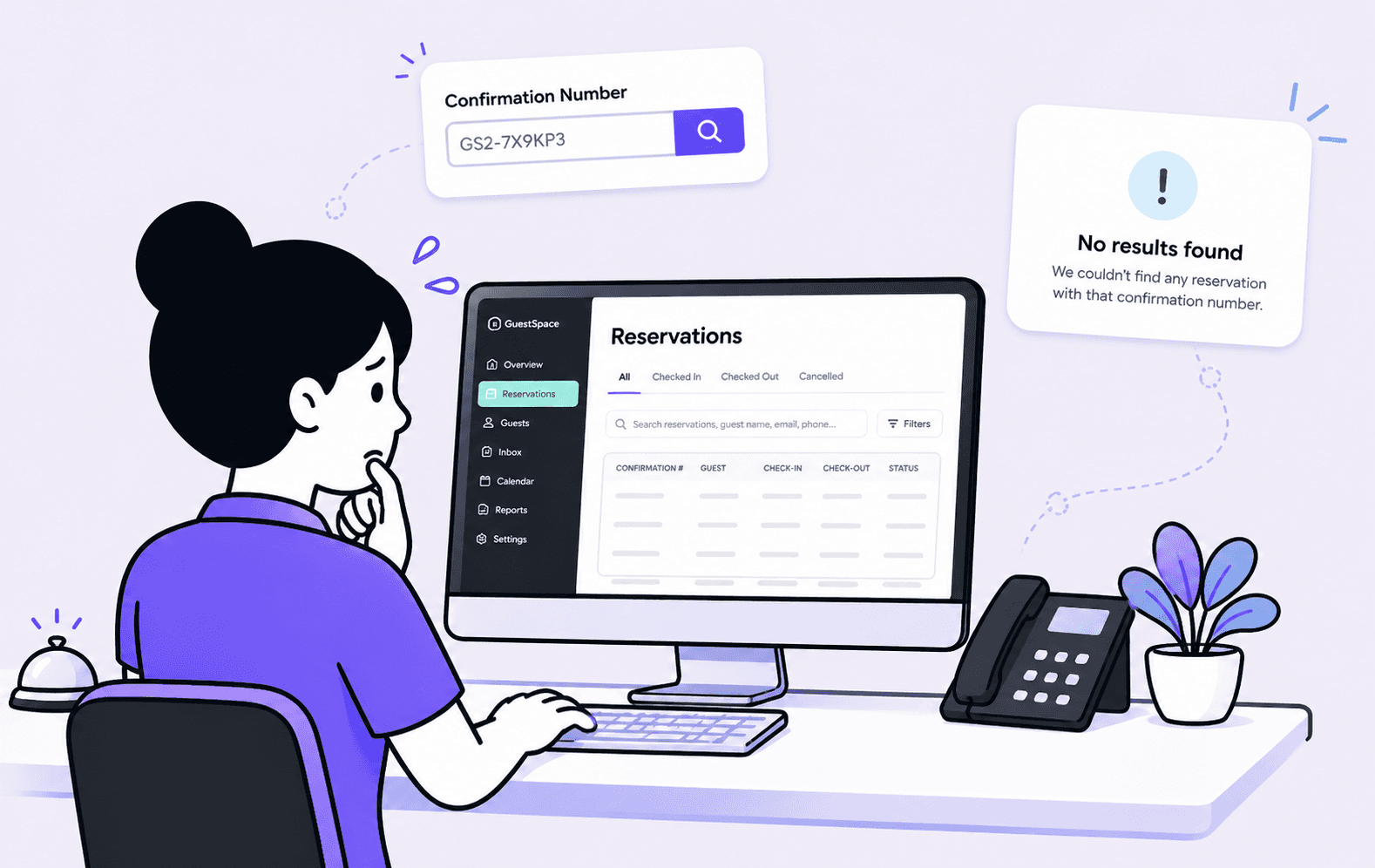
When search works for one booking source but fails for another, staff lose time and guests lose confidence. This is usually not a front-desk problem—it is an identifier mapping problem.
Why read this now?
You’ll get a practical framework, measurable KPIs, and implementation steps that can be actioned by operations teams this month.
What is actually happening behind the scenes
One reservation can carry multiple IDs (OTA ID, channel manager ID, PMS ID). Agents search one ID, while the record is indexed under another.
Where this hurts operations most
Pre-arrival changes that require quick lookup.
Peak check-in windows with high queue pressure.
Late-night support where staffing is thin.
The practical architecture fix
Create a canonical reservation identity layer.
Store all alias IDs for each booking (OTA, PMS, channel manager).
Normalize formatting (prefixes, dashes, casing).
Use confidence-ranked matching rather than hard zero-results.
Fast rollout plan (30 days)
Week 1: classify top 100 failed lookups by source.
Week 2: build alias mapping rules per integration.
Week 3: deploy fallback fuzzy search + source labels.
Week 4: QA with real support scenarios and update runbook.
KPIs that prove improvement
Lookup success rate by source channel.
Average time-to-find reservation.
Manual fallback rate.
Guest-facing resolution time for booking identity issues.
Data points to strengthen this article
Cloudbeds + Stripe case reference: Stripe reports Cloudbeds platform users grew revenue by 15% in one case study; unified transaction visibility was highlighted as an operational benefit.
Source: https://stripe.com/customers/cloudbeds
Suggested visuals (to make this post more useful)
Data model diagram: OTA ID ↔ Channel ID ↔ PMS ID ↔ Canonical ID.
Before/after table: search success by source.
Annotated search UI showing source tags + confidence score.
Free image search starting points: https://unsplash.com/s/photos/hotel-front-desk | https://www.pexels.com/search/hotel/
SEO implementation checklist for this post
Use a compelling title tag (50–60 chars) with keyword near the start.
Write meta description (140–160 chars) with clear value proposition.
Add FAQ section + FAQ schema.
Add 3–6 internal links to product pages, case studies, and related posts.
Add Article schema and set canonical URL.
Add one custom chart/diagram so the page has unique assets.
Conclusion
The best hotel content is specific, practical, and measurable. If readers can apply it in tomorrow’s shift briefing, it will outperform generic thought leadership.
Read Next



Copyright © 2026 All rights reserved.

Top 3 Guest Apps
Globally
2026

Made in
the Netherlands
Amsterdam

GDPR-compliant
2026
Made for Europe