
Are Guest Requests Slipping Through the Cracks?

Sophie de Jonge
Head of Onboardings
Whether your guest messages come via AI chat, WhatsApp, email, or front-desk notes, one risk is universal: requests that no one truly owns. The result is the same—delays, repeat contacts, and frustrated guests.
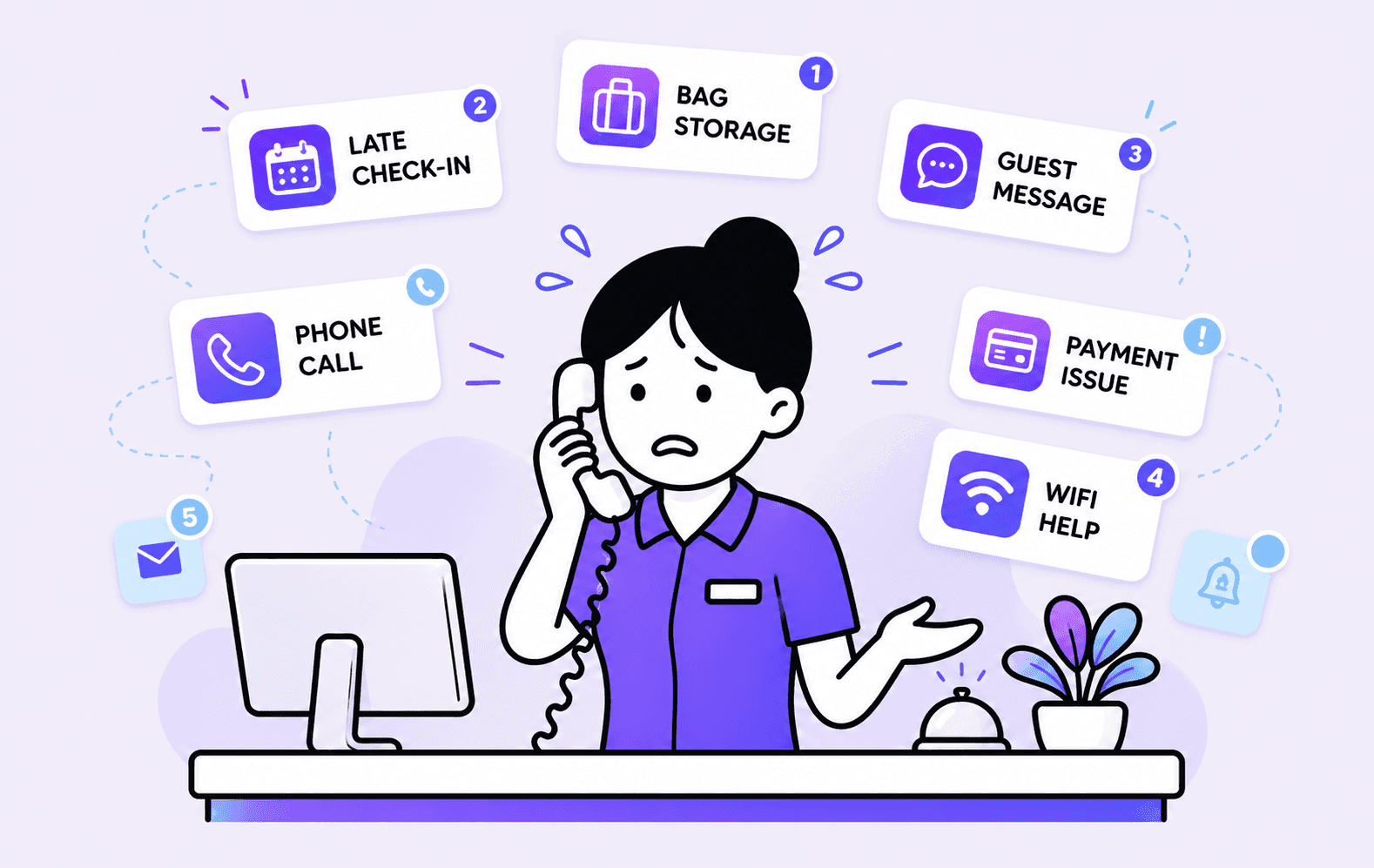
Whether your guest messages come via AI chat, WhatsApp, email, or front-desk notes, one risk is universal: requests that no one truly owns. The result is the same—delays, repeat contacts, and frustrated guests.
Why this matters to every hotel
AI-heavy hotels risk bot-to-human handoff gaps.
Low-AI hotels still face shift handovers, inbox overload, and channel fragmentation.
Any missed request during pre-arrival or in-stay can hurt reviews and revenue.
The core problem (in plain language)
Hotels do not usually fail because staff don’t care. They fail because ownership is unclear at handover moments. A guest asks for something, a colleague is mentioned, but there is no explicit accepted owner + due time + visibility in one queue.
5 signs your hotel has a handover reliability issue
Guests follow up with “just checking if someone saw this.”
Different team members ask the same guest for the same info.
Requests are marked “handled” without guest confirmation.
No one can quickly answer: “What is currently pending right now?”
Issues spike during shift changes or busy check-in windows.
Universal fix: the Handover Reliability Framework
Status model: New → Assigned → Accepted → Resolved → Confirmed.
Every guest request gets an owner and due time.
One shared pending queue across all channels.
Escalation reminders at fixed SLA intervals.
Closure only after clear outcome (resolved or explicitly deferred).
Start this week (practical rollout)
Day 1: audit 50 recent guest requests and label handover failures.
Day 2–3: define one queue and owner rules by request type.
Day 4: add SLA reminders and acceptance tracking.
Day 5–7: run shift-level review and remove ambiguous statuses.
KPIs hoteliers should track
Pending-request visibility rate (target: 100%).
Median time from request to accepted owner.
Resolution within SLA by request category.
Repeat-contact rate on same request.
Guest satisfaction on requests requiring handover.
Useful stat context
AHLA has repeatedly reported material staffing pressure in hotels, which increases the cost of missed handovers.
Source: https://www.ahla.com/news/65-surveyed-hotels-report-staffing-shortages
Conclusion
This is not just an AI problem. It is an operations reliability problem. Hotels that make ownership explicit at every handover reduce stress for teams and create a calmer, more trustworthy guest experience.
Read Next



Copyright © 2026 All rights reserved.

Top 3 Guest Apps
Globally
2026

Made in
the Netherlands
Amsterdam

GDPR-compliant
2026
Made for Europe